
Confirm file format and reference conventions
IGV / 007 · Genome inspection
Interactive Genome Browser
Web-native inspection of genomic tracks and candidate loci using IGV.js.
SCIENTIFIC PURPOSE
Lets researchers visually inspect alignment, coverage and variant tracks near regions of interest in a browser.
Who it helps
- Genomics researchers
- Sequencing laboratories
- Cancer genomics teams
- Bioinformatics educators
Supported inputs
- Indexed BAM/CRAM where supported
- VCF and BED tracks
- Reference genome coordinates
Useful outputs
- Interactive genomic tracks
- Locus-level inspection
- Coverage and alignment context
PROJECT INTELLIGENCE
A structured view of
scope and evidence.
These figures describe the documented public surface—not biological performance, clinical validity or benchmark superiority.
IGV / 007Working demonstration
IGV.js genomic renderingCoordinate navigationMulti-track comparisonDATA CONTRACT
What enters, what happens,
what leaves.
01 / INPUT
Indexed BAM/CRAM where supported
VCF and BED tracks
Reference genome coordinates
02 / ANALYSIS
01Select a reference genome
02Add supported tracks
03Navigate to a locus
04Inspect alignments and variants
05Record the visual evidence
03 / OUTPUT
Interactive genomic tracks
Locus-level inspection
Coverage and alignment context
EVIDENCE & INTERPRETATION MATRIX
How to use the project responsibly.
DimensionPublic evidenceInterpretation boundary
Interface1 documented viewsScreenshots demonstrate interaction patterns, not scientific validation.
MethodsIGV.js genomic rendering · Coordinate navigation · Multi-track comparisonMethod presence does not establish suitability for every dataset.
ReproducibilityDefined inputs, stages and outputsVersions, parameters and data provenance must accompany a real analysis.
Scientific useResearch exploration and communicationNo medical, diagnostic or treatment conclusion is produced.
BEFORE INTERPRETATION
Record tool, database and dataset versions
Inspect missing values, outliers and sample labels
Review assumptions behind each selected method
Keep exported figures linked to their source data
Request domain-expert review for consequential claims
TYPICAL RESEARCH FLOW
- 01
Select a reference genome
- 02
Add supported tracks
- 03
Navigate to a locus
- 04
Inspect alignments and variants
- 05
Record the visual evidence
INTERFACE GALLERY
Multiple views,
one research task.
Project demonstration captures. Displayed material may be benchmark or demonstration data and is not clinical evidence.
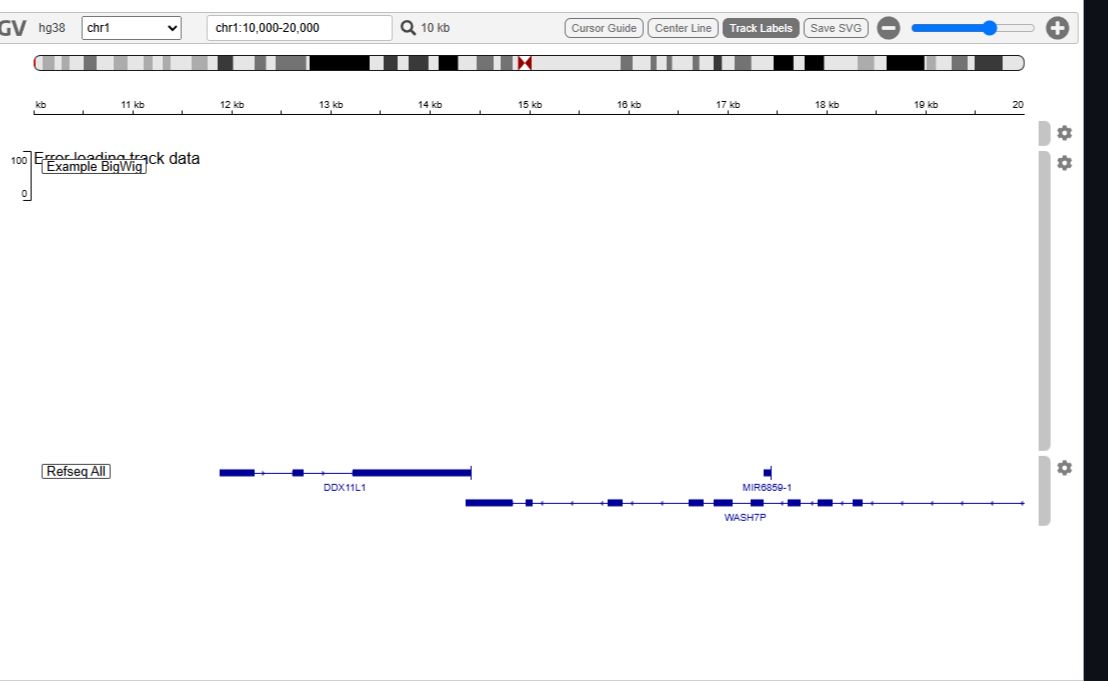
METHODS REPRESENTED
IGV.js genomic renderingCoordinate navigationMulti-track comparison
KNOWN LIMITATIONS
- Visual confirmation is not independent variant validation
- Large files require appropriate hosting and indexes
- Reference-build consistency is essential
USEFUL QUESTIONS
Before using the output.
Can it open any BAM file directly?
Efficient browser access normally requires a compatible index and byte-range-accessible file location.
Does a visible read prove a variant?
No. Visual inspection is one part of a broader validation workflow.